 Family Portal
  Employees
  Portuguese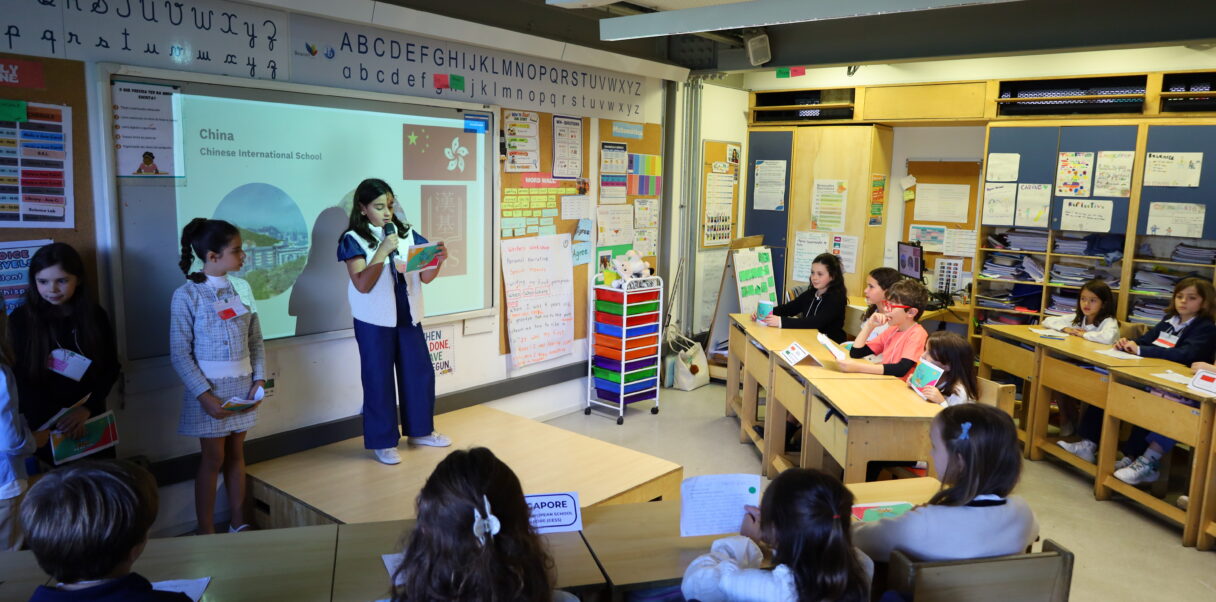
13.10.2026
As part of the Natural Resources Unit of Inquiry, within the transdisciplinary theme Sharing the Planet, Year 3 students took part in COP Beacon, a child-friendly simulation of the United Nations Conference of the Parties (COP). The project was the culmination of an inquiry journey into natural resources, their use, and the responsibility we have in the choices we make.
Guided by the central idea, “Our choices can support the sustainable use of natural resources,” students investigated what natural resources are, how they can be classified as renewable or non-renewable, how they are present in our daily lives, and the impacts of their use. Throughout this journey, they also expanded their vocabulary and understanding of sustainability, discussing concepts such as consumption, conservation, waste, pollution, reuse, recycling, biodiversity, and responsibility.
The inquiry began very close to home: within the school itself.
Students explored different areas of the Beacon campus and interviewed staff members to understand how our community uses natural resources, which sustainable practices are already part of our daily routines, and which aspects could still be improved. Through this process, they learned to formulate questions, listen to different perspectives, record relevant information, and use the findings from their interviews as evidence for their research.
Through informational texts, research, videos, and different visual and multimodal resources, students learned about sustainability initiatives developed by schools in China, Kenya, Indonesia, Singapore, and India. Reading was therefore directly connected to a real purpose for inquiry. Students searched texts for important information, identified main ideas and supporting details, expanded their vocabulary related to natural resources, and used different reading strategies to understand new information. They also compared what they learned about other schools with the practices they observed at Beacon.
The research opened the door to an even more important question.
What can we do with everything we have learned?
To answer this question, students began studying persuasive writing. They learned that a persuasive text needs to present a clear point of view, support it with reasons, examples, and evidence, and use language that can convince an audience. They explored the organization of a speech, the use of linking words and arguments, and how to construct a conclusion that reinforces the main idea or presents a call to action.
With this knowledge, each group began turning their findings into concrete proposals for the school. Students planned, wrote, revised, and edited their own speeches, thinking not only about what they wanted to say, but also about whom they were writing for and their purpose. Throughout the writing process, they exchanged ideas with classmates and teachers, received feedback, revisited their work, and made changes to make their ideas clearer, more organized, and more convincing.
But writing the speech was only part of the challenge. Students also needed to be prepared to deliver their speeches. For this reason, oral communication played a fundamental role throughout the project. During research, discussions, and rehearsals, they practiced communicating their ideas clearly and effectively in English, respecting speaking turns, listening to different perspectives, and responding meaningfully to their classmates’ contributions.
During rehearsals for COP Beacon, they worked on key aspects of oral presentation: clarity, speaking pace, volume and tone of voice, eye contact, body posture, and audience engagement. They also learned to use feedback and self-correction strategies to improve their communication and gain confidence when speaking in front of others.
This entire journey was collaborative. In their groups, students took on different responsibilities, organized their work, made decisions, negotiated ideas, listened to their peers, and contributed to a shared goal. In this way, in addition to developing knowledge about natural resources and skills in reading, writing, and speaking, the project engaged important Approaches to Learning (ATLs), particularly communication, research, thinking, collaboration, and self-management skills.
The journey culminated in COP Beacon, when students presented their speeches to the school’s Sustainability Committee. Drawing on evidence collected through interviews, research on other schools, and the knowledge they had developed throughout the unit, the groups presented proposals for new sustainable actions that could be implemented at Beacon.
At this moment, different strands of learning came together: researching to understand, reading to find information, comparing different realities, writing to persuade, collaborating to develop ideas, and speaking to a real audience with the intention of creating change.
In the Primary Years Programme (PYP), inquiry becomes even more meaningful when learning leads to action. COP Beacon enabled students to understand that sustainability is not simply a topic to be studied, but a shared responsibility. By observing their own community, learning about different perspectives, questioning existing practices, researching possibilities, and communicating their proposals, they came to understand that our choices have an impact on the resources we share.
More than learning about a sustainable future, students had the opportunity to realize that their voices and choices, even as children, can help build it.
13.10.2026
COP Beacon Y3
As part of the Natural Resources Unit of Inquiry, within the transdisciplinary theme Sharing [ ... ]
09.10.2026
Conference Cycle – Renata Cafardo – How Can We Educate Our Children Before the Algorithms?
On the evening of October 7, Beacon welcomed journalist and writer Renata Cafardo for anothe [ ... ]
08.10.2026
Literary Narratives and Their Contribution to the Socioemotional Development of Young Children
“If I were to teach a child the art of reading, I would not begin with letters and syllables [ ... ]