 Family Portal
  Employees
  Portuguese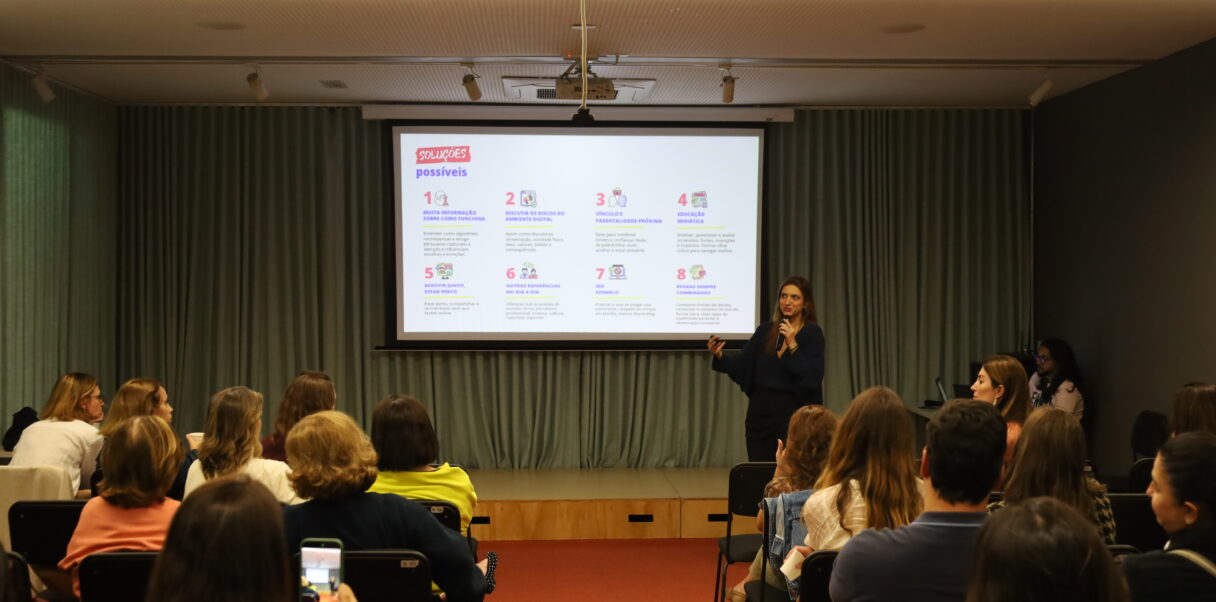
09.10.2026
On the evening of October 7, Beacon welcomed journalist and writer Renata Cafardo for another Conference Cycle event. A specialist in education, special correspondent and columnist for Estadão, Renata is the founder and president of the Associação de Jornalistas de Educação (Jeduca) and author of O algoritmo das famílias: como o mundo digital desafia a parentalidade, which served as the starting point for an important conversation about childhood, adolescence, and parenting in a world increasingly shaped by technology.
Under the title “How Can We Educate Our Children Before the Algorithms?”, the conversation began with an important observation: digital life is no longer separate from the lives of children and teenagers. Algorithms, social media, games, artificial intelligence, and digital platforms increasingly shape how young people build relationships, access information, form opinions, and develop their identities.
Renata explored some of the mechanisms that make this environment particularly challenging. Infinite scrolling, short-form videos, autoplay, notifications, and recommendation systems are not neutral features; they are part of an economy that constantly competes for our attention. As she emphasized during the event, “the business of big tech is our attention.” At the same time, she stressed that understanding these risks does not mean demonizing screens. The challenge is to educate children and teenagers to navigate a new, complex, and constantly changing environment.
This perspective shifts a very common question — How much screen time should my child have? — toward perhaps more important questions: What criteria are they developing to make choices? Do they know how to recognize reliable sources? Do they understand why certain content captures their attention? Can they question what an algorithm offers them? And what references do they find in the adults around them?
This was one of the questions that also guided the conversation: before algorithms compete for our children’s attention, desires, and identities, what do we need to help them build?
In her book, Renata argues that being a good parent today does not mean obsessively monitoring every minute spent online, but rather building criteria, references, and dialogue. This involves talking about how platforms work, questioning the intentions behind the content we consume, teaching children to seek reliable sources, and, above all, maintaining an open relationship in which children and teenagers feel able to share their questions, discomforts, and fears.
The conversation also addressed the role of schools. Renata highlighted the importance of media literacy, both at home and in educational settings: learning to distinguish journalism from influence, verify sources, understand information bubbles, and recognize how digital environments can create a false sense of consensus. In a context of artificial intelligence and an abundance of information, simply accessing answers is no longer enough. As she put it during the event, “the future does not belong to those who access information, but to those who interpret, connect, and give it meaning.”
Another important point was the need to avoid turning this discussion into yet another source of guilt for families. Parents are up against companies with enormous technological, economic, and persuasive power. For this reason, Renata advocated for shared responsibility involving families and schools, as well as regulation, platform oversight, and collective agreements capable of protecting children and teenagers.
In this sense, the event reinforced something at the heart of the relationship between Beacon and its families: education is a collective responsibility. Limits are necessary, but so are dialogue, presence, growing autonomy, and adults who are willing to enter this universe alongside children — watching, playing, asking questions, understanding, and helping them develop their own criteria.
Perhaps one of the most powerful messages of the evening was that we do not have to choose between absolute control and unrestricted freedom. As Renata writes in her book, our challenge is to “provide a secure foundation without preventing exploration; accompany without invading; guide without suffocating; set limits without breaking the dialogue.”
In a world where technology will continue to change faster than any parenting manual can keep up, some principles remain. The book closes with the reminder that parenting continues to be an experience built on “love and dedication, information and care, presence and connection” — and never on perfection.
It was with this invitation to reflection, shared responsibility, and, above all, presence that we brought another Conference Cycle to a close.
09.10.2026
Conference Cycle – Renata Cafardo – How Can We Educate Our Children Before the Algorithms?
On the evening of October 7, Beacon welcomed journalist and writer Renata Cafardo for anothe [ ... ]
08.10.2026
Literary Narratives and Their Contribution to the Socioemotional Development of Young Children
“If I were to teach a child the art of reading, I would not begin with letters and syllables [ ... ]
30.09.2026
Choice Time: When Choice Becomes Learning
What happens when we give young children the freedom to choose? At first glance, Choice Time [ ... ]