 Family Portal
  Employees
  Portuguese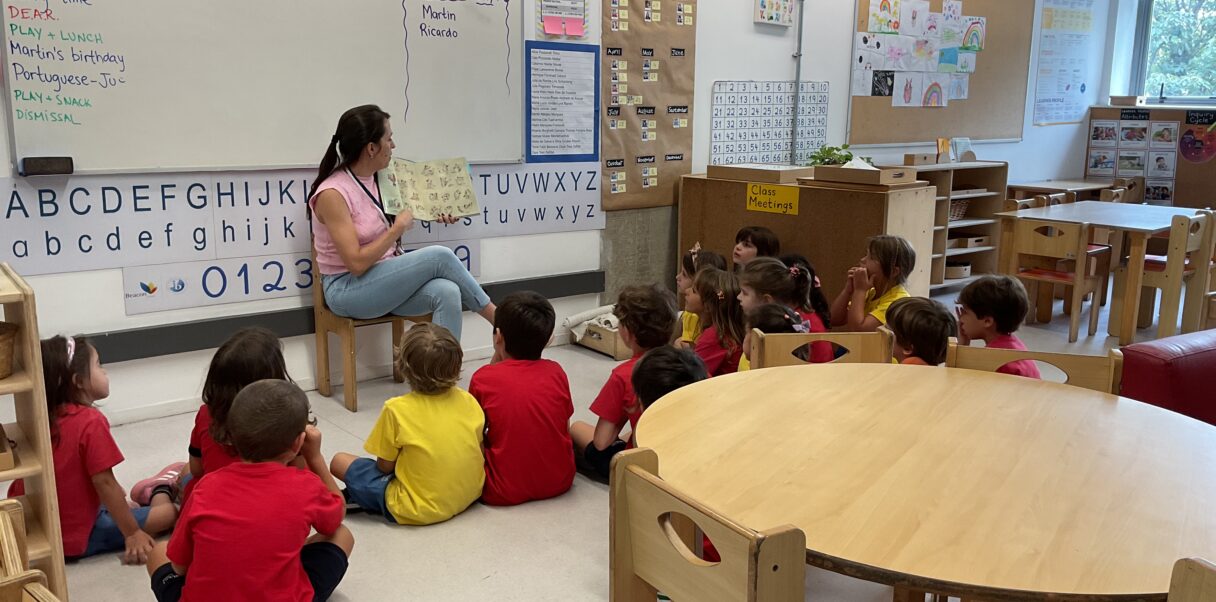
30.09.2026
What happens when we give young children the freedom to choose?
At first glance, Choice Time might look like a simple moment in the day when children decide what they would like to do. But in our ECE classrooms, Choice Time is much more than that. It is a carefully prepared learning moment where choice, independence, inquiry, observation, and intentional teaching come together.
At Beacon, our ECE program is grounded in the IB curriculum and inspired by Montessori and Reggio Emilia practices. Choice Time is one moment where we can see this blend come to life.
We intentionally prepare the environment before the children arrive. Materials are accessible, organized, and presented in a way that invites children to explore. The learning engagements on the shelves connect to the grade-level learning expectations. They may invite children to investigate, create, practice a skill, revisit an idea, or explore something that has sparked their curiosity. The child makes the choice, but the environment is intentionally prepared.
Choice Time is not simply “free play,” nor does it mean that children can do anything they want. It is freedom within limits. Children have genuine opportunities to make decisions, move through the environment, select materials, and follow their interests, while learning to respect the space, the materials, and the people around them. Play is embedded in Choice Time—but it is purposeful play: children’s interests and choices are honored while teachers intentionally create learning opportunities.
And this is where the teacher’s role becomes essential and interesting.
During Choice Time, the teacher is constantly observing. What is the child choosing? How are they approaching the material? Are they persevering when something is challenging? Are they communicating an idea? Are they working independently or seeking collaboration? What are they already able to do, and what might be their next step?
Sometimes, the teacher observes from a distance, allowing the child time and space to develop concentration and independence. At other moments, the teacher works with an individual child or a small group, intentionally supporting a learning goal or extending an investigation.
Choice Time, therefore, is both child-led and teacher-intentional.
The materials also play an important role. Inspired by Montessori, hands-on materials allow children to learn through doing, repeating, manipulating, and discovering. Practical Life experiences support independence, coordination, concentration, and responsibility. Inspired by Reggio Emilia, Investigative Centers, Story Workshop, and Make Believe give children opportunities to express ideas, construct meaning, collaborate, and explore their theories.
Even something as simple as a rug has a purpose. A rug creates a defined workspace and communicates, “This work is in progress.” Children learn to carry, unroll, use, and put away their rugs. They learn to walk around someone else’s work rather than through it. Through these small, everyday actions, children develop independence, empathy, respect, responsibility, and care for the environment.
Some children may also choose to have their snack during this time. This is also part of the learning. Pouring, serving, opening containers, cleaning up, and recognizing their own needs are opportunities to develop autonomy within the daily routine.
What may seem like a quiet moment in the classroom is actually filled with learning.
There is concentration.
There is problem-solving.
There is communication.
There is creativity.
There is collaboration.
There is independence.
There is investigation.
There is reflection.
And a teacher carefully watches, listens, and responds.
Bringing together the strengths of different educational approaches without losing sight of what matters most — the child.
Choice Time is not about choosing between learning and play. It creates an environment where children can learn through meaningful choices, purposeful play, and intentional experiences.
And perhaps most importantly, it gives children the opportunity to experience themselves as capable learners — children who can choose, explore, make mistakes, try again, solve problems, care for others, and construct their own understandings.
Because sometimes, giving children the space to choose is one of the most intentional things a teacher can do.
Priscila Amado – G3 Coordinator at Beacon School
30.09.2026
Choice Time: When Choice Becomes Learning
What happens when we give young children the freedom to choose? At first glance, Choice Time [ ... ]
22.09.2026
Beija-Flor Program 2027: Applications Open Until September 30
Applications for the Beija-Flor Program are open until September 30. One of the initiatives [ ... ]
16.09.2026
Educating Today: Between Knowledge, Experience, and Community
What is the role of school in a world where information is increasingly accessible? This is [ ... ]