 Family Portal
 Employees
 Portuguese
05.11.2026
When I think about the teenager I once was, I remember a girl who studied to get “somewhere.” The goal was to get into a good university, preferably a public one. That was how we learned to measure success. I don’t remember my coordinator’s name. In fact, I don’t even know whether they were a man or a woman. I knew the principal from a distance, as a figure of authority and discipline. I was the kind of student who went unnoticed. I wasn’t brilliant, but I wasn’t trouble either. I did what was expected of me and moved on.
Today, as an educator, I often think about that girl. And, above all, about everything no one ever got to discover about her. I also think about how many teenagers walk through school hallways carrying doubts, talents, insecurities, and dreams that don’t always find room to emerge. Because there is so much more to a student than their grades, assignments, or what they show inside a classroom.
Adolescence is an extraordinary time. Intense, contradictory, and full of discoveries. It is a time to explore possibilities, question certainties, seek belonging, and discover who you are. And I deeply believe that every teenager needs opportunities to surprise themselves. They need to feel that someone believes in them, even when they are not yet able to believe in themselves. Perhaps that is why I believe so strongly in experiences that take our students beyond the school hallways.
Because on these journeys, no one goes unnoticed.
In the Amazon, I watched our students discover new ways of learning, connecting with others, and seeing the world. Away from their usual surroundings, their contact with nature, local communities, and stories so different from their own seemed to awaken a genuine curiosity. There was something special about watching them ask questions, listen attentively, and allow themselves to be surprised by what they encountered along the way. Among so many meaningful encounters, I remember their excitement when meeting Izolena, a riverside community leader who, when she was a teacher, found in nature the paints she did not have access to. What began as a necessity became a source of knowledge, creativity, and possibility. Today, those same colors adorn bio-jewelry that has made its way onto the runways of major fashion brands around the world.
More than simply admiring her journey, our students seemed to discover that knowledge does not belong to just one place, and that the ability to transform reality can emerge precisely from what we have around us. And then there was that sunset over the Rio Negro. Teenagers accustomed to the fast pace of reels, screens, and images that disappear within seconds were completely absorbed. No rush. Just standing before something that needed no filters, explanations, or anything else beyond an attentive gaze.
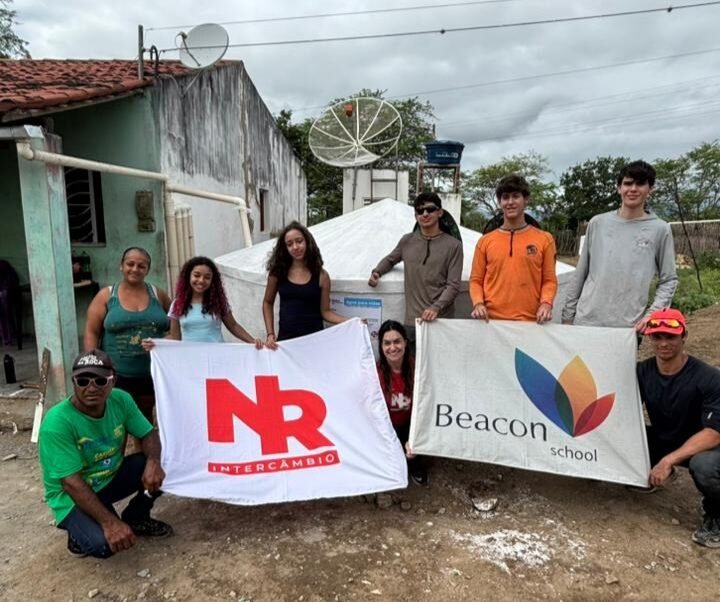
In the Brazilian Sertão, I watched literature come to life before our eyes. The landscapes, animals, and stories of the people seemed to give shape to the pages of Vidas Secas by Graciliano Ramos and the verses of Morte e Vida Severina by João Cabral de Melo Neto. Works our students had encountered throughout high school were no longer confined to books. They began to connect with what they could see, hear, and feel. Water, such a constant presence in our daily lives, took on a different meaning when faced with families who must consider every drop in order to survive. Alongside the hardships of that reality, we also encountered the generosity and resilience of those who build their lives in that region. Because the Sertão cannot be defined by scarcity alone. It holds stories, knowledge, and a human richness that no reading, on its own, could ever fully reveal. What had once been academic content now had faces, voices, and stories. And perhaps that is precisely where learning finds one of its deepest meanings: when what we know begins to transform the way we see the world.
But there is one moment that still gives me goosebumps. We were sitting in a circle with the families who had welcomed us. One by one, the students began to speak. To express their gratitude. To share what they had felt. People from different backgrounds, beliefs, and realities were simply wishing one another well. There was no right answer to give, no grade to earn, no academic expectation to fulfill. There were simply people who, after spending a few days sharing experiences, had something genuine to say to one another.
I looked at those teenagers and thought about how much beauty there is within them that we do not always get to see. Because adolescence is also about that. It is about intensity, uncertainty, and the search for belonging. But, above all, it is about potential.
And there is something that moves me deeply: seeing how much one teenager can inspire another. Through a classmate who offers to help, a group that finds a solution together, or someone who shows courage when everyone else is still hesitant. Often, motivation does not come from adult guidance, but from connection, shared experiences, and the desire to be part of something greater. There is a carefully designed curriculum behind these experiences. There is knowledge, planning, and pedagogical purpose. The curriculum provides context, tools, and pathways to understand the world. But it is the experience that transforms what we learn into something that becomes part of who we are.
And perhaps the most beautiful part is realizing that we, as educators, return changed as well.
We come back having discovered sides of our students we might never have known within the school environment. We uncover talents, generosity, vulnerabilities, and courage that cannot be captured in reports or assessments. We see young people taking responsibility, supporting their peers, listening to stories, and finding their own ways to contribute. I think again about the teenager I once was. About the girl who went unnoticed, with no idea of how many possibilities still lay within her. Today, I have the privilege of accompanying young people as they discover their own. And perhaps one of the greatest responsibilities of an educator is precisely this: never allowing our view of a student to be limited to what they are already able to show.
I know that not every transformation happens before our eyes. Some take time. Others may only make sense many years later. But that does not diminish the value of each encounter, each discovery, or each small shift in perspective. I like to imagine that every student returns from these journeys carrying something they did not pack in their suitcase. A memory, a question, a new sense of curiosity, or a different way of looking at themselves and the world. The ground beneath our feet in Brazil revealed much more than landscapes and stories. It revealed teenagers who feel deeply, who care, who surprise us, and who have so much to offer.
And, to me, education is a little like that: seeing possibilities in every young person that they themselves have not yet discovered, and believing in those possibilities until one day they are able to see them too.
Karine Pinto e Vairo
General Coordinator of High School

05.11.2026
Beacon’s Head of School Leads International Debate on AI in Education
We are proud to share that Dr. Elizabeth Sutherland, Beacon’s Head of School, was a featured [ ... ]
05.11.2026
How Schools and Families Work Together to Support Children’s Holistic Development.
Co-Education and Collective Responsibility in Holistic Development A child experiences devel [ ... ]
05.11.2026
What the Hallways Don’t Show and Brazil’s Ground Revealed
When I think about the teenager I once was, I remember a girl who studied to get “somewhere. [ ... ]