 Family Portal
 Employees
 Portuguese
26.11.2026
Elizabeth Sutherland – Principal at Beacon School
Dr. Elizabeth Sutherland, Head of School at Beacon School in São Paulo, presented research on oral language, play, and multilingual early literacy at the ECIS Early Childhood Conference, “Right Here, Right Now: Rethinking Early Childhood in a Changing World”, and the Bright Start International Conference 2026, a hybrid early childhood education event.
Dr. Sutherland’s work sits where educational research and school leadership meet. Her doctoral research at the University of North Carolina at Chapel Hill examined global-mindedness among school principals, and its central themes- the role of language and lived experience in shaping a global outlook and the need to turn theory into practice- now inform her research and practice in multilingual classrooms.
Her recent sessions applied that research orientation to early literacy. Both examined Story Workshop, an approach developed through teacher research at Opal School in Portland, Oregon (MacKay, 2021). Both argued from the literature for three claims. Oral narrative is a foundation for later reading and writing. Open-ended materials let young children build and rehearse narrative before they can write it. Home languages are a resource for that development rather than an obstacle to it.
Story Workshop and loose parts
Story Workshop is organized in four stages: a provocation (a book, object or question that prompts curiosity), story creation with materials, oral sharing with peers, and reflection on what the children did as storytellers. The approach began when teachers at Opal School asked how literacy and the arts connect (MacKay, 2021). Children draw, build, and talk through their ideas before they write them down, and keep doing so as they learn to write.
This parallels the Reggio Emilia concept of the “hundred languages” of children, in which thoughtfully arranged materials act as a “third teacher” (Edwards et al., 2012). Because children draw on their own experiences, cultures, and languages, MacKay characterizes the practice as culturally responsive.
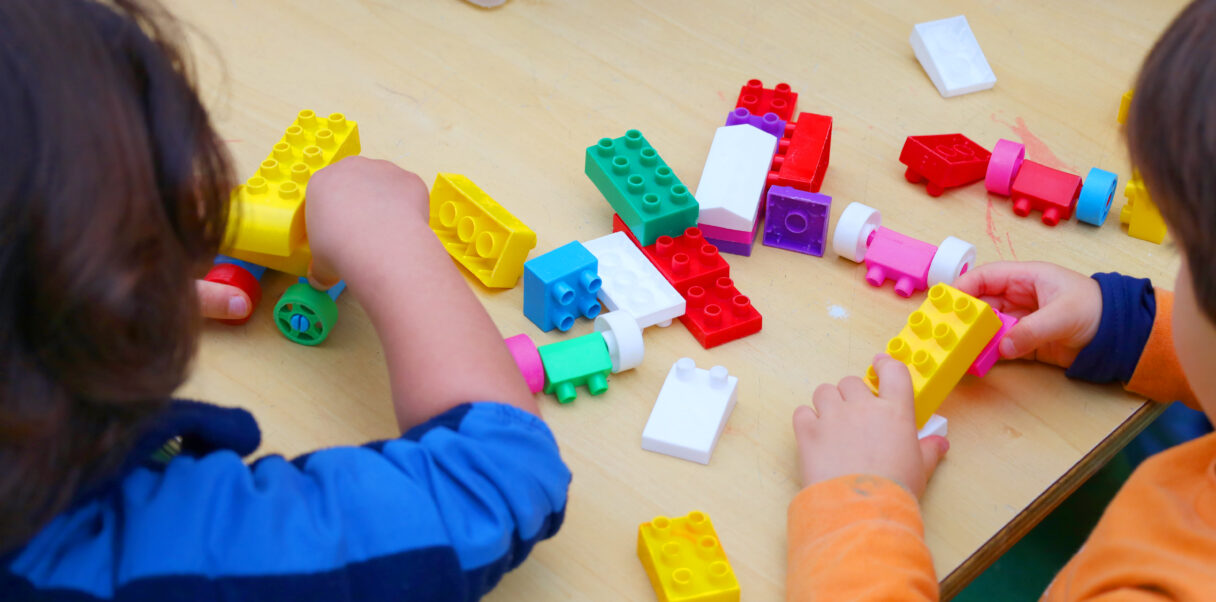
Loose parts provide the material base. The term comes from the architect Simon Nicholson (1971), who argued that inventiveness and discovery in an environment increase with the number and kind of variables it offers. In Story Workshop, small sets of open-ended materials, such as buttons, fabric, wooden figures, pinecones and glass gems, are arranged on a tray or placemat that serves as a story stage. Dr. Sutherland emphasized curation over quantity: three to five categories, sorted with a purpose and presented as an invitation.
The two sessions
At the ECIS Early Childhood Conference, Dr. Sutherland led a practitioner workshop built around Pete the Cat and His Four Groovy Buttons (Litwin, 2012). Participants built and told stories with loose parts, analyzed the oral-language skills involved, and planned adaptations for multilingual and mixed-age classrooms. At the Bright Start International Conference, she presented the research base for the approach.
The research presented
Play and guided play
The American Academy of Pediatrics links play to the development of executive function, language, and self-regulation (Yogman et al., 2018). Zosh et al. (2018) describe play as a spectrum running from free play, through guided play, to direct instruction. Story Workshop sits in the guided-play range: the teacher selects the provocation and materials, and the child directs the story.
The strongest quantitative support for guided play is a meta-analysis by Skene et al. (2022) of 17 studies involving 3,893 children aged one to eight. Guided play had a greater effect than direct instruction on early mathematics (g = 0.24), shape knowledge (g = 0.63) and task switching (g = 0.40), and a greater effect than free play on spatial vocabulary (g = 0.93). It was not less effective than direct instruction on any outcome, although differences for other outcomes, including literacy, were not significant.
Oral narrative and later literacy
Griffin et al. (2004) found in a longitudinal study that the structure of children’s oral narratives at age five was associated with the quality of their written narratives at age eight. Nicolopoulou et al. (2015) reported that preschoolers in a year-long storytelling and story-acting practice made gains in narrative and oral language, emergent literacy, and social competence. Dr. Sutherland used these findings to frame four skills that oral storytelling exercises develop: sequencing, vocabulary, perspective-taking, and emotion expression.
Home languages and multilingual learners
In a randomized study of Spanish-speaking three- to five-year-olds, Spencer et al. (2020) found that narrative lessons in both Spanish and English improved oral language in both languages. Research on translanguaging shows young children drawing on all their languages in story play (Kirsch & Mortini, 2021). Work on identity texts links multilingual students’ engagement with literacy to work that reflects who they are (Cummins & Early, 2011), and WIDA (2024) identifies oral language as the foundation of reading.
Materials and symbolic development
Dr. Sutherland proposed a progression in children’s use of materials, from realistic objects to lookalike substitutes, open-ended objects, and finally drawings, words, and numbers. It draws on Bruner’s (1966) account of enactive, iconic and symbolic representation. It also draws on Elder and Pederson’s (1978) finding that children of about two and a half pretend with dissimilar objects only some of the time, while children of about three and a half do so readily. Vygotsky (1978) argued that gesture, symbolic play and drawing precede written language. The implication for practice is that younger children and newer language learners benefit from realistic materials as anchors, with open-ended materials added as symbolic thinking develops.
Limits of the evidence
Story Workshop has been documented largely through teacher research, so the studies above test its components rather than the approach as a whole. On loose parts, a systematic review by Gibson et al. (2017) identified only five quantitative studies of their effects on cognitive, social and emotional development, with mixed results. Dr. Sutherland identified this gap as one reason for her own research interest in the area.
Practice at Beacon School
Both sessions drew on Beacon’s Early Years, where Story Workshop is part of regular classroom practice and many children are learning in more than one language. At Bright Start, an example was shown of three points in a child’s development: setting up a story stage, retelling in another language a story she had heard, and later telling a story with fewer materials, a clearer sequence and greater confidence.
At Beacon, we see four patterns in children’s storytelling since introducing Story Workshop. Children have moved from naming objects to telling stories with a beginning, middle and end, using sequence words such as “first”, “next” and “at the end”, consistent with Griffin et al. (2004) and Nicolopoulou et al. (2015). Handling materials has prompted more precise descriptive and positional vocabulary, such as “roll”, “bounce”, “under” and “behind”, in line with the spatial-vocabulary effect reported by Skene et al. (2022).
Children who are quiet in whole-group settings often tell their first stories in a home language before retelling them in a second language, as Spencer et al. (2020) would predict. Children also increasingly question and extend one another’s stories, the peer-audience effect described by Nicolopoulou et al. (2015) and MacKay (2021).
Connection to Dr. Sutherland’s doctoral research
Dr. Sutherland’s doctoral research at the University of North Carolina at Chapel Hill examined the global-mindedness of public high school principals in North Carolina (Sutherland, 2015). The mixed-methods study combined a demographic survey, the Global-Mindedness Survey, and school characteristics data. It explored how principals’ global-mindedness related to student achievement and to their own backgrounds, and how they understood global awareness.
The study identified the experiences that shape a school leader’s global outlook. Travel experience, together with gender, race and ethnicity, was most strongly related to global-mindedness, and the number of languages a principal spoke fluently, school size and years in education showed further, weaker associations. Rather than a direct link between principals’ survey scores and student test results, the study pointed to a different opportunity: principals’ understanding of global awareness was still developing and largely theoretical. Its central recommendation is that school leaders be supported to turn global-mindedness into concrete school practice, the work Dr. Sutherland has pursued since.
The two conference sessions respond to that conclusion in a specific setting. They take research on play, oral narrative, and multilingual development and show how it is applied and observed in a multilingual school. Story Workshop’s treatment of home languages as a resource also connects to the dissertation’s attention to language as one dimension of global-mindedness, here at the level of the youngest learners rather than school leaders.
Subsequent research drawing on the study
Sutherland (2015) has since been cited in research on global-mindedness in higher education, primary schooling and adolescent development. Three of these studies are summarized here.
Matheus and Gaugler (2020) evaluated a two-week, community-based global learning program in the Dominican Republic, in which university students of computer science and Spanish designed and ran a technology summer camp for junior-high students. In reviewing how Hett’s (1993) Global-Mindedness Scale has been applied, they cite Sutherland (2015) as an example of its use beyond study abroad research, to examine global-mindedness in relation to principals’ demographic variables and school characteristics. Their own pre- and post-test results showed significant gains on all five dimensions of the scale: responsibility, cultural pluralism, efficacy, global centrism and interconnectedness.
Thompson (2019) cites the dissertation among studies of international mindedness that left a gap at the level of the IB Primary Years Programme. His qualitative study of one PYP teacher and 11 students identified four themes in an internationally minded curriculum: passion, intentionality, modeling and reflection. It also produced a reflective tool that, he suggests, could inform teacher hiring and professional development.
Huang et al. (2024) also cite Sutherland (2015). Using two-level hierarchical linear modeling with 2,448 Finnish 15-year-olds, they found that a school aim focused on academic achievement positively predicted students’ global-mindedness, while an employability aim had a negative effect, with tolerance mediating these relationships. Their findings concern students rather than leaders, but they extend the question the dissertation asked about how global-mindedness and academic achievement are related.
The dissertation also belongs to a small body of research on global-mindedness in school leadership. Hersey (2012), studying leaders of primary schools offering international programs, found relationships between global-mindedness and travel experience, second-language ability and years of teaching experience, results that align with Sutherland’s findings on travel and languages. Tichnor-Wagner (2019) interviewed eleven principals and identified ten globally minded leadership practices, grouped under setting the direction, developing people, redesigning the organization, and situating “glocally”. Taken together, these studies point to the need the dissertation identified: preparing school leaders to turn global-mindedness into practice.
26.11.2026
Story Workshop and Loose Parts: Research and Practice in Multilingual Early Years Classrooms
Elizabeth Sutherland – Principal at Beacon School Dr. Elizabeth Sutherland, Head of Sc [ ... ]
11.11.2026
Designed to Discover
By: Paola de Albuquerque Costa – G4 Coordinator A prepared environment is never neutra [ ... ]
05.11.2026
Beacon’s Head of School Leads International Debate on AI in Education
We are proud to share that Dr. Elizabeth Sutherland, Beacon’s Head of School, was a featured [ ... ]