 Family Portal
 Employees
 Portuguese
16.06.2021
By Bruna Cronfli and Matheus Alves
The 8th-grade students (Y8) have been developing several types of research on energy, mainly electric power. As a trigger to the discussions, they watched a series of videos called “Viagem na Eletricidade” – French educational animations from the ’80s. In a playful way, the series addresses basic electricity concepts, strongly focusing on positive and negative poles. This material was the trigger for the students to start raising hypotheses about the subject. Adding all the knowledge acquired during the Design Lab classes and the investigations related to the videos was necessary to visualize in a practical way how electricity works. Thus, the students decided that they would build homemade batteries.
As part of the energy theme, several aspects were explored: use, production, transformation, and storage of energy, dirty/fossil and clean/renewable/green sources, currents, circuits, voltage, and the concept of energy.
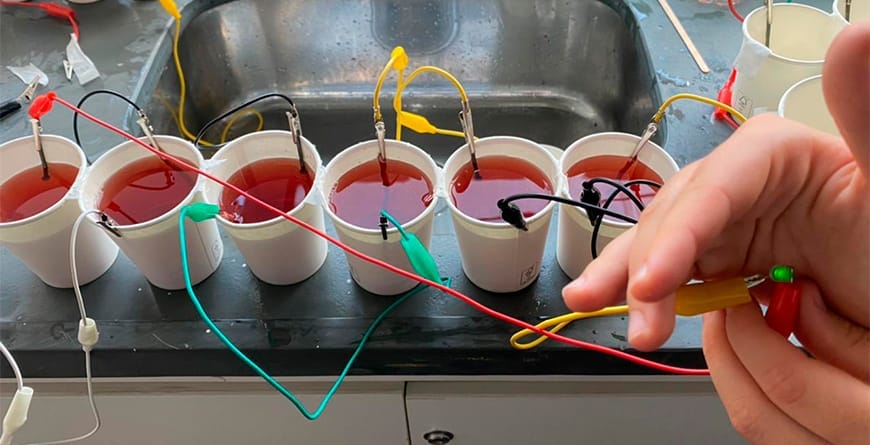
The students needed a positive pole to make the battery, which they obtained by stripping electrical wires and using copper. They used zinc from nails and screws for the negative pole, and finally, an acidic solution, vinegar. With these elements, they developed batteries capable of generating 3 Volts, enough electrical voltage to light small LED bulbs.
Joining the production of batteries to the concept of sustainable energy, the groups discussed whether it would be possible to achieve the reverse process. Instead of using batteries (chemical energy) to produce light, why not use sunlight to make batteries? The challenge now is to build homemade photovoltaic panels, which in the future will replace the batteries used to move the electric carts created by the 7th-grade students (Y7).
The purpose of the following steps is to understand the concept of parallel and series connections. Students also intend to investigate ways for Beacon to save more energy and, with this, understand the functioning of an electrical circuit for when they advance to 9th grade (Y9).
13.10.2026
COP Beacon Y3
As part of the Natural Resources Unit of Inquiry, within the transdisciplinary theme Sharing [ ... ]
09.10.2026
Conference Cycle – Renata Cafardo – How Can We Educate Our Children Before the Algorithms?
On the evening of October 7, Beacon welcomed journalist and writer Renata Cafardo for anothe [ ... ]
08.10.2026
Literary Narratives and Their Contribution to the Socioemotional Development of Young Children
“If I were to teach a child the art of reading, I would not begin with letters and syllables [ ... ]